Convert android app to ios – Embark on a captivating expedition as we delve into the realm of changing Android purposes for the iOS platform. The world of cellular apps is a dynamic panorama, the place innovation thrives, and consumer expectations repeatedly evolve. Think about remodeling your Android creation right into a glossy iOS counterpart, increasing your attain and interesting a complete new viewers. This endeavor is not nearly shifting code; it is about understanding the intricacies of each platforms, navigating the distinctive challenges, and seizing the chance to ship a seamless and interesting consumer expertise.
This journey will uncover the essential components of app conversion. We’ll discover the varied vary of Android app sorts, from the only consumer interfaces to advanced backend integrations, and establish the options that pose the largest hurdles. Uncover the array of conversion strategies out there, weighing the benefits and downsides of cross-platform frameworks towards native growth approaches. We’ll meticulously analyze the conversion course of, from the preliminary code evaluation to the ultimate App Retailer submission, making certain your app shines on the iOS platform.
Lastly, we’ll handle the vital features of code adaptation, rigorous testing, and post-conversion upkeep, guaranteeing a clean and profitable transition in your app and its customers.
Understanding the Scope of the Conversion: Convert Android App To Ios
Changing an Android software to iOS is a multifaceted enterprise, requiring cautious consideration of the appliance’s performance, structure, and target market. The scope of this conversion can range considerably, relying on the app’s complexity, options, and the underlying applied sciences employed. This part delves into the nuances of assessing the scope, offering a transparent understanding of the challenges and issues concerned.
Kinds of Android Apps and Their Complexity Ranges, Convert android app to ios
The panorama of Android purposes is huge and various, encompassing a large spectrum of functionalities and complexities. Understanding these differing types is essential for precisely assessing the scope of a conversion challenge.
- Easy UI Apps: These purposes primarily give attention to displaying info and offering a fundamental consumer interface. Examples embrace easy calculators, note-taking apps, or fundamental information readers. Conversion for these apps sometimes includes recreating the UI components and implementing the core functionalities in Swift or Goal-C. The complexity is usually low, making the conversion course of comparatively easy.
- Apps with Advanced Backend Integration: These purposes rely closely on backend companies for information storage, processing, and retrieval. Examples embrace social media apps, e-commerce platforms, and apps that work together with cloud companies. The conversion course of requires not solely recreating the UI but in addition making certain seamless integration with the prevailing backend infrastructure. This will likely contain porting API calls, dealing with information synchronization, and managing consumer authentication.
The complexity is reasonable to excessive, relying on the backend’s structure.
- Apps with Superior UI/UX: Functions that prioritize a classy consumer expertise typically incorporate customized animations, advanced UI layouts, and interactive components. Examples embrace artistic apps, video games with intricate interfaces, and apps with dynamic content material rendering. Changing these apps requires cautious consideration to element to make sure the iOS model maintains the identical degree of visible enchantment and consumer engagement. This typically includes important UI/UX design work and should require using superior iOS frameworks.
- Video games: Recreation growth is a singular area inside app growth. Video games typically leverage particular sport engines (Unity, Unreal Engine, and so forth.) and require important effort to port the sport logic, graphics, and consumer interactions to iOS. This conversion course of is usually probably the most advanced, requiring a deep understanding of sport growth rules and iOS-specific applied sciences.
- Apps with {Hardware} Integration: Functions that work together with system {hardware}, equivalent to cameras, GPS, or sensors, current further challenges. Examples embrace health trackers, augmented actuality apps, and apps that make the most of NFC or Bluetooth. Changing these apps requires cautious consideration of platform-specific APIs and {hardware} capabilities.
Inherently Troublesome Options to Replicate on iOS
Sure options generally present in Android apps are inherently more difficult to copy on iOS as a consequence of platform variations and API limitations.
- Deep Linking and Intents: Android’s intent system, which permits apps to speak with one another and share information, has no direct equal on iOS. Whereas iOS gives deep linking capabilities, the implementation and performance are completely different, requiring important code adaptation.
- Background Processes and Companies: Android’s background companies and background execution fashions differ from iOS. iOS has stricter limitations on background duties to preserve battery life, which may affect options like information synchronization, notifications, and placement monitoring.
- Customized Widgets and Dwelling Display Integration: Android’s widgets, which permit customers to put interactive components on their house screens, will not be straight supported on iOS. Whereas iOS gives widgets, they’re applied otherwise and have restricted performance in comparison with Android widgets.
- {Hardware}-Particular APIs: Android’s entry to {hardware} options, equivalent to NFC and Bluetooth, might require important modifications through the conversion. iOS gives APIs for these options, however the implementation particulars and functionalities can differ, necessitating changes to the app’s code.
- Versatile UI Layouts: Android permits for extra versatile UI layouts throughout completely different display sizes and resolutions. iOS has its personal structure constraints and design rules. The conversion must keep in mind variations in display sizes and resolutions to make sure a constant consumer expertise.
Challenges in Changing Apps with {Hardware}-Particular Options
Changing apps that make the most of hardware-specific options, equivalent to NFC and Bluetooth, presents distinctive challenges as a consequence of platform-specific API variations and {hardware} limitations.
- NFC (Close to Discipline Communication): Whereas each Android and iOS assist NFC, the implementation and capabilities range. Android gives extra open entry to NFC {hardware}, permitting for a wider vary of purposes, equivalent to emulating NFC tags and studying/writing information. iOS has extra restricted NFC entry, primarily restricted to Apple Pay and studying NFC tags. Changing an Android app that extensively makes use of NFC requires cautious consideration of those limitations and should contain important code modifications.
- Bluetooth: Bluetooth is one other space the place Android and iOS have completely different implementations. iOS has stricter controls over Bluetooth connections, significantly for background operations. Changing an Android app that makes use of Bluetooth for system communication might require adapting the code to adjust to iOS’s Bluetooth necessities and making certain that the app capabilities accurately within the background.
- Digital camera and Sensors: Android and iOS have their very own digital camera APIs and sensor frameworks. Changing an app that closely makes use of the digital camera or sensors requires adapting the code to make use of the corresponding iOS APIs. This will likely contain adjusting picture processing algorithms, sensor information dealing with, and consumer interface components to match the iOS platform.
- GPS and Location Companies: Each platforms present location companies, however the implementation particulars and accuracy can range. Changing an Android app that makes use of GPS or location companies requires adapting the code to make use of the iOS location APIs and making certain that the app precisely retrieves and shows location information on iOS gadgets.
- {Hardware} Abstraction Layer (HAL) Variations: Android’s HAL gives a layer of abstraction between the working system and the {hardware}. iOS has its personal {hardware} abstraction layer. Changing an Android app that interacts straight with {hardware} requires adapting the code to make use of the iOS {hardware} abstraction layer.
Affect of App Complexity on the Conversion Course of
The complexity of an Android app has a direct affect on the time, value, and required experience for the conversion course of. This desk gives a normal overview of the connection between app complexity and these elements.
| App Complexity Stage | Time (Estimated) | Value (Estimated) | Required Experience |
|---|---|---|---|
| Easy UI Apps | 2-4 weeks | $5,000 – $15,000 | Intermediate iOS Developer |
| Apps with Advanced Backend Integration | 4-8 weeks | $15,000 – $50,000 | Skilled iOS Developer, Backend Engineer |
| Apps with Superior UI/UX | 6-12 weeks | $30,000 – $75,000 | Senior iOS Developer, UI/UX Designer |
| Video games | 8+ weeks | $50,000+ | Specialised Recreation Developer, iOS Experience |
| Apps with {Hardware} Integration | 6-12+ weeks | $25,000+ | Skilled iOS Developer, {Hardware} Integration Data |
Accessible Conversion Strategies

Changing an Android app to iOS is a journey with a number of paths, every providing its personal set of challenges and rewards. Selecting the best technique hinges on elements like price range, time constraints, desired efficiency, and the prevailing codebase’s complexity. This part delves into the assorted conversion strategies out there, offering a transparent understanding of their strengths, weaknesses, and ultimate purposes.
Cross-Platform Frameworks: Benefits and Disadvantages
Cross-platform frameworks have emerged as fashionable decisions for app growth, together with conversions. These frameworks enable builders to write down code as soon as and deploy it throughout a number of platforms, saving time and sources. Nonetheless, this strategy comes with trade-offs.
The benefits are important, together with:
- Code Reusability: The first benefit is the power to reuse a considerable portion of the codebase, lowering growth effort and time. In some instances, as much as 90% of the code could be shared between Android and iOS variations.
- Quicker Growth: Cross-platform frameworks typically present pre-built elements and UI components, accelerating the event course of in comparison with native growth. This can lead to faster time-to-market.
- Value-Effectiveness: By sharing code and lowering the necessity for separate groups for every platform, cross-platform growth could be extra budget-friendly, particularly for startups and small companies.
- Single Codebase Upkeep: Sustaining a single codebase simplifies updates and bug fixes, making certain consistency throughout each platforms.
Regardless of these advantages, there are additionally disadvantages to think about:
- Efficiency Limitations: Cross-platform apps might not at all times obtain the identical degree of efficiency as native apps, particularly in graphically intensive purposes or these requiring advanced animations. The efficiency hole is closing, however it’s nonetheless an element.
- UI/UX Variations: Whereas frameworks try for platform-agnostic UI, reaching a really native feel and look could be difficult. Builders may have to take a position further effort to customise the UI for every platform.
- Dependency on Framework Updates: Apps constructed with cross-platform frameworks are depending on the framework’s updates and bug fixes. Delays in framework updates can typically affect the app’s performance or compatibility.
- Potential for Vendor Lock-in: Switching frameworks is usually a advanced and time-consuming course of. Builders would possibly discover themselves locked into a particular framework.
Native Growth vs. Cross-Platform Options: Code Reusability
The selection between native growth (utilizing Swift/Goal-C for iOS) and cross-platform options is a vital determination. Native growth gives the perfect efficiency and entry to all platform-specific options, however at the price of separate codebases for Android and iOS. Cross-platform options prioritize code reusability, doubtlessly sacrificing some efficiency and platform-specific options.
Native Growth (Swift/Goal-C):
- Benefits:
- Optimum Efficiency: Native apps are constructed particularly for the platform, leading to superior efficiency and responsiveness.
- Full Function Entry: Native growth gives entry to all platform-specific APIs and options, equivalent to digital camera, GPS, and push notifications.
- Greatest UI/UX: Native apps can ship probably the most seamless and intuitive consumer expertise, adhering to platform-specific design pointers.
- Disadvantages:
- Increased Growth Prices: Growing separate native apps for Android and iOS requires two growth groups and a bigger price range.
- Longer Growth Time: Constructing native apps from scratch takes extra time than utilizing cross-platform frameworks, particularly for comparable functionalities.
- Code Duplication: Important code duplication happens when growing separate apps for every platform, resulting in elevated upkeep efforts.
Cross-Platform Options:
- Benefits:
- Code Reusability: Important parts of the codebase could be shared between Android and iOS, lowering growth effort and time.
- Quicker Growth: Cross-platform frameworks typically present pre-built elements and UI components, accelerating the event course of.
- Value-Effectiveness: By sharing code and lowering the necessity for separate groups, cross-platform growth could be extra budget-friendly.
- Disadvantages:
- Efficiency Limitations: Cross-platform apps might not at all times obtain the identical degree of efficiency as native apps.
- UI/UX Challenges: Reaching a really native feel and look could be difficult, requiring further effort for personalisation.
- Dependency on Framework Updates: Apps are depending on the framework’s updates and bug fixes.
Code Reusability Comparability:
The extent of code reusability varies relying on the chosen strategy and the app’s complexity. Cross-platform frameworks sometimes enable for reusing 60-90% of the code, whereas native growth requires writing separate codebases. In some instances, builders can use a shared logic layer (e.g., utilizing Kotlin Multiplatform) to share enterprise logic between native Android and iOS apps, growing code reuse. For example, a sport developed with a cross-platform framework like Unity can share the sport logic and belongings throughout platforms, lowering growth time.
Nonetheless, the UI and platform-specific options should still require platform-specific implementations.
Code Translators and Code Converters: Position, Limitations, and Use Circumstances
Code translators and code converters play a job within the app conversion course of, primarily by automating components of the method. They’ll robotically translate code written in a single language to a different, equivalent to changing Java (Android) to Swift/Goal-C (iOS).
Position:
- Automated Conversion: Code translators can robotically convert code from one language to a different, lowering handbook time and effort.
- Code Technology: They’ll generate code snippets or whole modules primarily based on current code, streamlining the event course of.
- Syntax Transformation: Translators can remodel code syntax to match the goal language’s necessities.
Limitations:
- Complexity Dealing with: Translators typically battle with advanced code buildings, platform-specific APIs, and complicated logic.
- Handbook Evaluation Required: Transformed code sometimes requires handbook evaluation and refinement to make sure accuracy and performance.
- Efficiency Points: The translated code is probably not optimized for the goal platform, doubtlessly impacting efficiency.
- Lack of Idiomatic Code: Translators might not produce code that adheres to the perfect practices and coding conventions of the goal language.
Perfect Use Circumstances:
- Easy Code Conversion: Translators are simplest for changing easy code blocks or fundamental functionalities.
- Prototyping: They can be utilized to shortly generate a prototype or a fundamental model of the app.
- Aiding with Handbook Conversion: Translators can help builders by offering a place to begin for handbook code conversion.
For instance, a code translator would possibly convert a Java perform to a Swift equal. Nonetheless, it will seemingly battle with advanced UI layouts or platform-specific options like Android’s Exercise lifecycle. On this situation, the translated code would function a place to begin, requiring handbook changes and optimizations by a talented developer. An actual-world instance is using automated code conversion instruments emigrate older Java-based Android apps to Kotlin, which may then be used as a base for conversion to iOS.
Well-liked Instruments and Frameworks for Android to iOS App Conversion
The next instruments and frameworks are fashionable decisions for Android to iOS app conversion, every with its personal set of options and capabilities.
- React Native: A JavaScript framework for constructing native cellular apps. It permits builders to reuse a good portion of their codebase throughout Android and iOS. React Native makes use of JavaScript to render native UI elements, providing a native-like consumer expertise.
- Flutter: Google’s UI toolkit for constructing natively compiled purposes for cellular, net, and desktop from a single codebase. Flutter makes use of the Dart programming language and gives glorious efficiency and a constant UI throughout platforms.
- Xamarin (with .NET MAUI): A Microsoft-owned framework for constructing cross-platform apps with C#. Xamarin permits builders to share code and UI components between Android and iOS. Xamarin has developed into .NET Multi-platform App UI (.NET MAUI), which gives much more unified cross-platform growth.
- NativeScript: An open-source framework for constructing native cellular apps with JavaScript, TypeScript, or Angular. NativeScript makes use of the native UI elements of every platform, offering a native-like consumer expertise.
- Kotlin Multiplatform Cellular (KMM): A Kotlin-based framework that enables builders to share enterprise logic between Android and iOS apps. KMM focuses on code sharing, permitting native UI implementation on every platform.
Selecting the Proper Method
So, you are able to port your Android app to iOS? Improbable! However earlier than you dive headfirst into the code, it’s essential to make some essential selections. Selecting the best conversion technique is like choosing the proper ingredient for a dish – it impacts every thing from the style (consumer expertise) to the fee (your price range) and the time it takes to organize (growth timeline).
Let’s get all the way down to brass tacks and determine the perfect path in your app.
Components in Deciding on a Conversion Technique
Deciding on the suitable strategy includes cautious consideration of a number of key components. It is like planning a street journey; you would not simply hop within the automotive with out checking the map, gas, and the climate forecast, would you?
- Finances: How a lot are you prepared to spend? Conversion strategies range wildly in value. A easy cross-compilation is perhaps cheaper upfront, however an entire rewrite may prevent cash in the long term if it leads to a greater consumer expertise and lowered upkeep prices.
- Timeline: How shortly do you want your iOS app? Some strategies, like utilizing a cross-platform framework, can considerably pace up growth, whereas others, like a local rewrite, take extra time.
- Desired Efficiency: Do you want peak efficiency, or is a good-enough answer acceptable? Native apps typically provide the perfect efficiency, whereas cross-platform options would possibly contain trade-offs.
- App Complexity: Is your app easy or advanced? A easy app is perhaps appropriate for cross-compilation, whereas a fancy app with platform-specific options might necessitate a extra concerned strategy.
- Staff Experience: What expertise does your staff possess? Have they got expertise with Swift/Goal-C, or are they extra comfy with JavaScript or C#?
- Platform-Particular Options: Does your app closely depend on options distinctive to Android? These would possibly require extra work to implement on iOS. Think about using {hardware} elements like digital camera, GPS, or different system sensors.
Growth Time Comparability for Every Technique
Growth time is a vital issue. Let us take a look at approximate timelines for various strategies, remembering that these are estimates and might range primarily based on app complexity and staff expertise.
- Cross-Compilation (e.g., utilizing instruments like Kotlin Multiplatform Cellular): This may be comparatively quick, doubtlessly taking 1-3 months for a reasonably advanced app, however efficiency is usually a concern. The precise time is determined by the diploma of code reuse and the complexity of the UI and platform-specific integrations.
- Cross-Platform Frameworks (e.g., React Native, Flutter, Xamarin): These frameworks can considerably cut back growth time, doubtlessly 2-6 months for a reasonably advanced app. The time financial savings come from code reusability, however you would possibly want to take a position time studying the framework. Think about the affect of updates to the framework on the challenge.
- Hybrid Apps (e.g., utilizing frameworks like Ionic or Cordova): These apps are sometimes sooner to develop than native apps, however slower than some cross-platform approaches, taking round 3-8 months. They leverage net applied sciences (HTML, CSS, JavaScript) inside a local container, which may affect efficiency.
- Native Rewrite (Swift/Goal-C): This strategy typically takes the longest, doubtlessly 4-12 months or extra, relying on the app’s complexity. Nonetheless, it gives the perfect efficiency and permits for full utilization of iOS options. Take into consideration the period of time required for UI/UX redesign and testing.
Affect of Goal Viewers and Platform-Particular Options
Your target market and the options you want play a big position. In case your app targets a worldwide viewers, cross-platform frameworks is perhaps a good selection, permitting you to succeed in each Android and iOS customers extra shortly.
- Goal Viewers: In case your target market is primarily iOS customers, a local app is perhaps well worth the funding for a superior consumer expertise. In the event you’re concentrating on each Android and iOS customers equally, a cross-platform answer may very well be a less expensive strategy.
- Platform-Particular Options: In case your app depends closely on platform-specific options (e.g., augmented actuality utilizing ARKit on iOS or particular {hardware} integrations), a local strategy or a cross-platform framework that gives good assist for these options is perhaps needed. Take into consideration options equivalent to push notifications, Apple Pay integration, or SiriKit assist.
Professionals and Cons of Totally different Conversion Approaches
Here is a desk summarizing the professionals and cons of various conversion strategies. This desk ought to present a transparent and concise overview of the choices.
| Method | Professionals | Cons | Estimated Growth Time (Average Complexity) |
|---|---|---|---|
| Cross-Compilation (e.g., Kotlin Multiplatform Cellular) | Code reuse, potential for sooner growth, maintains native efficiency. | Restricted UI customization, efficiency is usually a concern, might require adapting code. | 1-3 months |
| Cross-Platform Frameworks (e.g., React Native, Flutter, Xamarin) | Code reuse, sooner growth, single codebase, wider attain. | Efficiency trade-offs, potential for UI limitations, reliance on framework updates, doable want for native code for particular options. | 2-6 months |
| Hybrid Apps (e.g., Ionic, Cordova) | Quicker growth than native, use of net applied sciences (HTML, CSS, JavaScript), simpler upkeep for net builders. | Efficiency limitations, reliance on net applied sciences, could be much less user-friendly than native apps. | 3-8 months |
| Native Rewrite (Swift/Goal-C) | Optimum efficiency, full entry to iOS options, greatest consumer expertise. | Longer growth time, requires platform-specific experience, greater value. | 4-12+ months |
The Conversion Course of
Alright, so you have determined to make the leap and remodel your Android app into an iOS masterpiece. It is a journey, not a dash, and understanding the steps concerned is vital to a profitable conversion. Consider it like a rigorously choreographed dance, the place every step results in the following, culminating in an attractive and purposeful app on the App Retailer.
Let’s dive in and break down the conversion course of, step-by-step, making certain you’ve gotten a transparent roadmap to navigate this thrilling endeavor.
Preliminary Steps: Code Evaluation and Mission Setup
Earlier than you even take into consideration writing a single line of Swift or Goal-C, it’s essential to perceive the panorama. This includes an intensive code evaluation of your Android app. The aim is to establish the core functionalities, dependencies, and structure. This preliminary evaluation helps decide the perfect strategy for the conversion, whether or not you are leaning in the direction of an entire rewrite, utilizing a cross-platform framework, or choosing a extra hybrid strategy.
That is the place you place in your detective hat and begin digging!The challenge setup section includes creating a brand new Xcode challenge in your iOS app. You may have to configure the challenge settings, together with the app identify, bundle identifier, and goal deployment model. Establishing the event atmosphere is essential for constructing and testing your app on iOS gadgets. It’s like organising the stage earlier than the present begins – you want the suitable instruments and a well-defined area to work in.
Additionally, you will have to deal with the dependencies. Android apps depend on Gradle or Maven, whereas iOS makes use of CocoaPods or Swift Package deal Supervisor. This includes creating a brand new challenge in Xcode, selecting the suitable template (Single View App, Tabbed App, and so forth.), and configuring the challenge settings to match your app’s necessities.
Adapting the Person Interface (UI) for iOS
The consumer interface is the face of your app, and it is important to tailor it for the iOS ecosystem. Android and iOS have distinct design languages, so you will have to make platform-specific changes to make sure a local feel and look. Consider it as giving your app a contemporary new wardrobe that matches completely.This contains adapting UI components like buttons, textual content fields, and navigation bars to align with iOS design pointers.
iOS makes use of a design philosophy often called Human Interface Tips (HIG), which emphasizes readability, simplicity, and user-friendliness. You may want to think about elements like display sizes, facet ratios, and contact interactions particular to iOS gadgets. For instance, the again button is perhaps on the highest left on iOS, whereas it is sometimes on the highest or backside on Android.Adapting the UI would possibly contain an entire redesign or a extra incremental strategy, relying on the chosen conversion technique.
In the event you’re utilizing a cross-platform framework, some UI components is perhaps robotically transformed, however you will seemingly have to customise them for iOS. For example, you would possibly substitute Android’s Materials Design elements with iOS’s UIKit or SwiftUI elements.Here is an instance: Think about your Android app makes use of a floating motion button (FAB) within the backside proper nook. On iOS, that is much less frequent.
As a substitute, you would possibly combine the same motion inside a navigation bar or a tab bar, adhering to the iOS HIG.
Porting Backend Performance
Your app’s backend is the engine that powers its core performance, and porting it requires cautious planning. This includes adapting server-side logic, database integration, and some other backend companies to work seamlessly together with your iOS app.The backend typically handles duties like consumer authentication, information storage, and API interactions. You would possibly want to regulate your server-side code to deal with requests out of your iOS app, particularly in case your Android app makes use of a unique API or information format.
Database integration is one other essential facet. You may want to make sure that your iOS app can connect with your current database or migrate the info to a brand new one. This would possibly contain utilizing completely different database drivers or adapting your database queries to match the iOS platform.For instance, in case your Android app makes use of Firebase Realtime Database, you should use the Firebase SDK for iOS to seamlessly combine together with your current database.
Integrating Platform-Particular Options
To create a really native iOS expertise, you will have to combine platform-specific options that improve consumer engagement and performance. This contains options like push notifications, in-app purchases, and integration with Apple companies.* Push Notifications: Implementing push notifications means that you can ship well timed updates and alerts to your customers, even when the app will not be actively working. You may have to configure your app to obtain push notifications from Apple’s Push Notification service (APNs).
In-App Purchases
In case your app gives in-app purchases, you will have to combine with Apple’s In-App Buy system. This permits customers to buy digital items or unlock premium options inside your app.
Apple Companies Integration
Think about integrating with Apple companies like iCloud, HealthKit, or Core Location to supply further performance and improve the consumer expertise. For instance, you can use Core Location to supply location-based options or combine with HealthKit to trace well being information.That is the place your app actually begins to shine, leveraging the distinctive capabilities of the iOS platform. It is like including the key sauce that makes your app irresistible.
Typical Steps Concerned in Changing an Android App to iOS
Here is a helpful checklist to information you thru the conversion course of:* Code Evaluation: Conduct an intensive evaluation of the Android app’s code, structure, and dependencies.
Mission Setup
Create a brand new Xcode challenge and configure the challenge settings for iOS.
UI Adaptation
Adapt the consumer interface to align with iOS design pointers and consumer expertise.
Backend Porting
Adapt server-side logic, database integration, and API interactions.
Platform-Particular Options
Combine options like push notifications and in-app purchases.
Testing and Debugging
Totally take a look at the iOS app on varied gadgets and debug any points.
Deployment
Submit the app to the App Retailer for evaluation and launch.
Code Adaptation and Refactoring
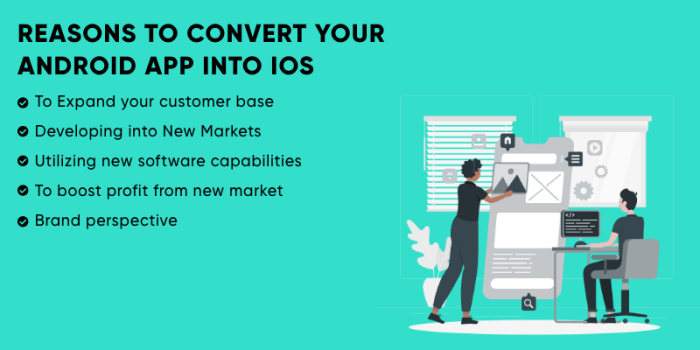
Changing an Android app to iOS is not merely a matter of a direct copy-and-paste. It is a journey of adaptation and meticulous refactoring. The 2 platforms, Android and iOS, are constructed on completely different foundations, with distinct programming languages, UI frameworks, and underlying APIs. This necessitates cautious code changes to make sure the app capabilities seamlessly and adheres to the iOS ecosystem’s conventions.
Code Examples Requiring Modification
A big a part of the conversion course of includes figuring out and modifying code segments particular to the Android platform. These sometimes contain dependencies on Android-specific libraries, UI elements, and system companies.Here is a breakdown of frequent code areas that usually require modification:
- UI Element Variations: Android makes use of XML for UI layouts, whereas iOS primarily makes use of Storyboards (or SwiftUI) and code. Adapting the UI typically includes recreating layouts and adapting part conduct.
- Platform-Particular APIs: Android and iOS have distinct APIs for accessing system options like location, digital camera, and sensors. Code utilizing `android.location` will have to be changed with iOS’s Core Location framework.
- Dependency Administration: Android makes use of Gradle for dependency administration, whereas iOS makes use of CocoaPods, Swift Package deal Supervisor, or Carthage. The conversion includes migrating dependencies to the suitable iOS package deal supervisor.
- Occasion Dealing with: Occasion dealing with paradigms differ. Android makes use of `OnClickListener` and comparable interfaces, whereas iOS makes use of target-action patterns and delegates.
Think about this illustrative instance: An Android app makes use of `SharedPreferences` to retailer easy key-value pairs. On iOS, you’ll use `UserDefaults`. The elemental perform is similar – storing consumer preferences – however the implementation differs.“`java// Android (Java/Kotlin)
SharedPreferences instance
SharedPreferences sharedPref = getPreferences(Context.MODE_PRIVATE);SharedPreferences.Editor editor = sharedPref.edit();editor.putString(“key”, “worth”);editor.apply();“““swift// iOS (Swift)
UserDefaults instance
let defaults = UserDefaults.standarddefaults.set(“worth”, forKey: “key”)defaults.synchronize()“`The core logic stays comparable, however the syntax and technique calls are platform-specific.
Addressing UI Design Sample Variations
The consumer interface is the face of your software, and a direct port typically feels clunky. Android and iOS have developed their very own UI design patterns, resulting in completely different consumer expectations.To efficiently adapt, contemplate these key areas:
- Navigation: Android generally makes use of a again button and a navigation drawer, whereas iOS emphasizes a hierarchical navigation construction with a again button on the prime and tab bars.
- UI Components: iOS makes use of particular UI components like `UINavigationController`, `UITabBarController`, and `UITableView` that haven’t any direct equivalents in Android.
- Gestures: iOS depends closely on gestures like swiping for navigation and interactions.
- Materials Design vs. Human Interface Tips: Android adheres to Materials Design, whereas iOS follows the Human Interface Tips. These pointers dictate the look, really feel, and interplay patterns of UI components.
For instance, an Android app would possibly use a `ViewPager` for swiping between completely different screens. In iOS, you’d seemingly use a `UIPageViewController` or a `UIScrollView` with paging enabled. The aim is to supply a UI that feels pure and intuitive to iOS customers.
Dealing with Platform-Particular API Calls and Libraries
Changing an app includes substituting Android-specific API calls with their iOS counterparts. This requires understanding the iOS frameworks that present equal performance.Here is a breakdown of some frequent API replacements:
- Location Companies: Android’s `android.location` package deal turns into iOS’s Core Location framework.
- Digital camera Entry: Android’s `android.{hardware}.Digital camera` is changed by iOS’s `AVFoundation` framework.
- Notifications: Android’s `android.app.NotificationManager` is swapped for iOS’s `UNUserNotificationCenter`.
- Storage: Android’s `SharedPreferences` and file system are changed by `UserDefaults`, Core Information, or file system entry in iOS.
For example, contemplate retrieving the system’s location.“`java// Android (Java/Kotlin)
Location retrieval
LocationManager locationManager = (LocationManager) getSystemService(Context.LOCATION_SERVICE);if (ActivityCompat.checkSelfPermission(this, Manifest.permission.ACCESS_FINE_LOCATION) == PackageManager.PERMISSION_GRANTED) locationManager.requestLocationUpdates(LocationManager.GPS_PROVIDER, 0, 0, locationListener);“““swift// iOS (Swift)
Location retrieval
import CoreLocationclass LocationManager: NSObject, CLLocationManagerDelegate let locationManager = CLLocationManager() override init() tremendous.init() locationManager.delegate = self locationManager.requestWhenInUseAuthorization() // or requestAlwaysAuthorization() locationManager.startUpdatingLocation() func locationManager(_ supervisor: CLLocationManager, didUpdateLocations places: [CLLocation]) if let location = places.final print(“Latitude: (location.coordinate.latitude), Longitude: (location.coordinate.longitude)”) “`The elemental activity is similar: to entry location information.
Nonetheless, the code construction, the required permissions, and the precise API calls are utterly completely different. This highlights the necessity to study the iOS equal APIs.
Code Examples: Key Variations
The next desk summarizes code examples that illustrate key variations between Android and iOS code, protecting varied features of app growth.
| Function | Android (Java/Kotlin) | iOS (Swift) | Description |
|---|---|---|---|
| UI Structure | XML structure recordsdata (e.g., `activity_main.xml`) | Storyboards (.storyboard) or code-based structure (utilizing `UIView` and constraints) | Illustrates the completely different approaches to UI design. Android primarily makes use of XML for structure definition, whereas iOS gives Storyboards or code-based approaches. |
| Button Click on Occasion |
      Button button = findViewById(R.id.myButton);
      button.setOnClickListener(new View.OnClickListener()
          @Override
          public void onClick(View v)
              // Motion to carry out

      );
|
      let button = UIButton(sort: .system)
      button.addTarget(self, motion: #selector(buttonTapped), for: .touchUpInside)
|
Demonstrates the distinction in occasion dealing with paradigms. Android makes use of `OnClickListener` interfaces, whereas iOS makes use of target-action patterns. |
| Community Request |
      // Utilizing HttpURLConnection (older strategy)
      URL url = new URL("https://instance.com");
      HttpURLConnection connection = (HttpURLConnection) url.openConnection();
      // ... course of response
|
      // Utilizing URLSession (trendy strategy)
      let url = URL(string: "https://instance.com")!
      let activity = URLSession.shared.dataTask(with: url)  information, response, error in
          // ... course of response

      activity.resume()
|
Reveals the distinction in making community requests. iOS’s `URLSession` is the popular technique, whereas Android gives `HttpURLConnection` and different libraries. |
| Information Storage (Easy) |
      SharedPreferences sharedPref = getPreferences(Context.MODE_PRIVATE);
      SharedPreferences.Editor editor = sharedPref.edit();
      editor.putString("key", "worth");
      editor.apply();
|
      let defaults = UserDefaults.normal
      defaults.set("worth", forKey: "key")
      defaults.synchronize()
|
Highlights the completely different strategies for storing easy key-value pairs. Android makes use of `SharedPreferences`, whereas iOS makes use of `UserDefaults`. |
| Accessing Machine Location |
      LocationManager locationManager = (LocationManager) getSystemService(Context.LOCATION_SERVICE);
      if (ActivityCompat.checkSelfPermission(this, Manifest.permission.ACCESS_FINE_LOCATION) == PackageManager.PERMISSION_GRANTED)
          locationManager.requestLocationUpdates(LocationManager.GPS_PROVIDER, 0, 0, locationListener);
|
      import CoreLocation
      let locationManager = CLLocationManager()
      locationManager.requestWhenInUseAuthorization()
      locationManager.startUpdatingLocation()
|
Demonstrates the way to retrieve system location information. Android makes use of the `LocationManager`, whereas iOS makes use of the `CoreLocation` framework. |
The desk clearly illustrates that whereas the underlying performance is perhaps comparable, the implementation particulars, the API calls, and the general strategy to coding differ considerably between the 2 platforms.
Testing and Debugging
After the Herculean effort of changing your Android app to iOS, the true enjoyable begins – making certain it truly
-works*! Thorough testing and meticulous debugging will not be simply steps; they’re the protection internet that stops your app from crashing and burning within the App Retailer. Consider it as the ultimate polish on a masterpiece, the final examine to make sure every thing is ideal earlier than unveiling it to the world.
A well-tested app equals joyful customers, and joyful customers are the lifeblood of any profitable app.
Significance of Thorough Testing and Kinds of Checks
The significance of testing cannot be overstated. It is the one option to catch these sneaky bugs, compatibility points, and efficiency hiccups that may flip a consumer’s expertise bitter sooner than a dropped ice cream cone. With out rigorous testing, you danger releasing an app riddled with issues, resulting in unfavorable critiques, uninstalls, and a bruised repute. Keep in mind, first impressions matter, and a buggy app makes a horrible first impression.
- Unit Checks: These exams are the microscopic examination of your code. They give attention to particular person elements or capabilities, making certain every one behaves as anticipated. Consider it as checking every gear in a clock to verify it turns easily. For instance, if in case you have a perform that calculates a consumer’s age, a unit take a look at would confirm that the perform returns the proper age primarily based on completely different enter dates.
- Integration Checks: Now, think about placing these gears collectively. Integration exams confirm that completely different elements of your app work collectively seamlessly. They examine how modules work together with one another, making certain information flows accurately and that options perform as a cohesive entire. This includes testing how completely different components of your app talk, such because the interplay between the consumer interface and the backend server.
- UI Checks: UI (Person Interface) exams simulate consumer interactions to make sure the app’s interface capabilities as supposed. These exams confirm the app’s responsiveness to consumer actions, the proper show of knowledge, and general consumer expertise. This includes checking components equivalent to button clicks, textual content enter, and display transitions. For instance, a UI take a look at would possibly confirm that tapping a button results in the anticipated display.
- Efficiency Checks: These exams are all about pace and effectivity. They measure how shortly your app hundreds, how effectively it makes use of sources (like reminiscence and battery), and the way nicely it handles heavy hundreds. They assist establish bottlenecks and areas for optimization. These exams contain measuring app startup time, response instances to consumer interactions, and the app’s reminiscence utilization.
- Regression Checks: After fixing bugs or including new options, regression exams be certain that the modifications have not launched new points or damaged current performance. They contain re-running beforehand profitable exams to confirm that the app nonetheless works as anticipated. This helps to take care of stability and forestall the introduction of recent bugs throughout growth.
Debugging on iOS Utilizing Xcode
Debugging on iOS is the place Xcode, Apple’s built-in growth atmosphere (IDE), actually shines. Xcode is your command middle, geared up with highly effective instruments that will help you monitor down and squash these pesky bugs. It’s like having a detective equipment in your code, full with magnifying glasses, fingerprint mud, and a complete lot extra.
The first software for debugging is the Xcode debugger, which lets you step by means of your code line by line, examine variables, and establish the supply of errors. Xcode gives a visible interface for setting breakpoints, that are factors in your code the place execution pauses, permitting you to look at the state of your program.
Xcode’s debugger gives quite a lot of options:
- Breakpoints: Set breakpoints in your code to pause execution at particular strains. This lets you examine variables and this system’s state at that time.
- Variable Inspection: Look at the values of variables and information buildings at any level throughout execution.
- Console Output: View console logs and print statements to trace the circulation of your program and establish errors.
- Reminiscence Debugging: Xcode gives instruments for figuring out reminiscence leaks and different memory-related points.
- Efficiency Profiling: Analyze the efficiency of your app to establish bottlenecks and optimize code.
Xcode additionally integrates with the iOS simulator, which lets you run and take a look at your app on varied digital iOS gadgets while not having a bodily system.
Simulating Totally different iOS Units and Display Sizes
Testing on quite a lot of gadgets and display sizes is essential to make sure your app appears to be like and capabilities accurately throughout the whole iOS ecosystem. Luckily, Xcode and the iOS simulator make this straightforward. The simulator enables you to select from a variety of gadgets, together with iPhones, iPads, and Apple Watches, every with completely different display sizes and resolutions.
To simulate completely different gadgets:
- Open Xcode: Launch the Xcode software.
- Choose a Machine: In Xcode, select a tool from the simulator menu. You possibly can entry this menu by going to “Xcode” -> “Open Developer Device” -> “Simulator”.
- Run Your App: Construct and run your app on the chosen system within the simulator.
The simulator gives an correct illustration of how your app will look and behave on the chosen system. You possibly can rotate the system, simulate community situations, and even take a look at push notifications. This complete testing helps you establish and repair any structure points or efficiency issues particular to sure gadgets or display sizes.
Key Testing Areas and Methods
Right here’s a roadmap to information you thru the testing section. Following these key areas and methods will assist guarantee your transformed app is prepared for prime time.
- Performance Testing: Confirm that each one options of your app work as supposed. Check core capabilities, information enter and output, and all consumer interactions. For instance, examine {that a} login kind works, the search perform returns related outcomes, and that in-app purchases perform accurately.
- UI/UX Testing: Make sure the consumer interface is intuitive and visually interesting. Verify for correct structure, responsiveness, and usefulness. Confirm that each one UI components are displayed accurately on completely different gadgets and display sizes.
- Efficiency Testing: Measure app pace, responsiveness, and useful resource utilization. Determine and handle any efficiency bottlenecks. Use Xcode’s efficiency instruments to watch CPU utilization, reminiscence consumption, and community exercise.
- Compatibility Testing: Check your app on completely different iOS variations and gadgets. Guarantee it really works accurately on the most recent iOS variations and older gadgets that will nonetheless be in use. Check on varied gadgets to make sure correct display measurement and backbone compatibility.
- Safety Testing: Confirm that your app is safe and protects consumer information. Verify for vulnerabilities, equivalent to insecure information storage, authentication flaws, and information transmission points.
- Localization Testing: In case your app helps a number of languages, take a look at the localization to make sure textual content and content material are displayed accurately in all supported languages. Confirm that the app’s consumer interface adapts to completely different languages and cultural conventions.
- Error Dealing with and Edge Case Testing: Check how your app handles errors and sudden conditions. Confirm that the app gracefully handles invalid enter, community errors, and different potential points.
- Beta Testing: Earlier than releasing your app to the general public, contemplate conducting a beta take a look at with a gaggle of customers. It will present precious suggestions on real-world utilization and assist establish any remaining points.
iOS App Retailer Submission
Alright, you have conquered the conversion, wrestled with the code, and now your shiny new iOS app is able to meet the world. However earlier than it might probably grace the screens of keen iPhone customers, it should navigate the often-intimidating waters of the App Retailer submission course of. Don’t be concerned, it isn’t as scary because it sounds. Consider it as a last, essential checkpoint in your journey to iOS app glory.
Let’s break down every thing it’s essential to know to get your app accredited and printed.
Necessities for App Retailer Submission: Provisioning Profiles and Certificates
Submitting an app to the App Retailer requires you to play by Apple’s guidelines, and people guidelines contain a couple of key elements: certificates and provisioning profiles. These are primarily digital passports and licenses that show your app is reliable and approved to run on iOS gadgets. It is like having the suitable paperwork to cross the border.
First, you will have to create an Apple Developer account. That is your key to the dominion, offering entry to the instruments and sources you want. Upon getting an account, you can begin creating the required certificates. There are several types of certificates, however an important ones for App Retailer submission are:
- Growth Certificates: Used for testing your app on actual gadgets throughout growth. Consider them as your backstage passes.
- Distribution Certificates: These are those it’s essential to truly submit your app to the App Retailer. They inform Apple that you’re the reliable developer of the app.
You may additionally have to create provisioning profiles. A provisioning profile is a mix of your distribution certificates, the app’s distinctive identifier (bundle ID), and the gadgets your app is allowed to run on (though for App Retailer submissions, it is for all gadgets). Here is the breakdown:
- App IDs: These uniquely establish your app. It is like your app’s social safety quantity. You may create one in your app in your Apple Developer account.
- Provisioning Profiles (Distribution): These are what enable your app to be put in on gadgets for testing after which submitted to the App Retailer. The provisioning profile accommodates the distribution certificates, the App ID, and an inventory of allowed gadgets (within the case of App Retailer submission, it is “all gadgets”).
Creating these can really feel a bit like studying a brand new language, however the Apple Developer portal gives glorious documentation and clear directions. Don’t be concerned, even seasoned builders need to revisit these steps once in a while. Consider it as a ceremony of passage. If you’re utilizing Xcode, it would typically deal with plenty of this robotically, making the method smoother.
A very powerful factor is to be organized and observe the steps rigorously. A misconfigured certificates or profile is a standard reason behind submission rejections.
Publish-Conversion Issues
So, you have efficiently navigated the treacherous waters of app conversion, remodeling your Android masterpiece into an iOS sensation! The champagne corks have popped, the confetti has settled, and the world is eagerly awaiting your app’s debut on the App Retailer. However maintain your horses, accomplice! The journey would not finish on the end line. Sustaining and nurturing your iOS app is a marathon, not a dash.
That is the place the true work, and the true enjoyable, begins.
Sustaining and Updating the iOS Model
The iOS ecosystem is a dynamic beast. Apple recurrently releases new iOS variations, introduces new {hardware}, and tweaks its design pointers. To maintain your app related, bug-free, and pleasant for customers, you want a strong upkeep and replace technique. Consider it like tending a backyard; it’s essential to water, weed, and prune recurrently to maintain it thriving.
- Common Updates: Schedule updates, even when they appear minor. Frequent updates display that you simply’re actively supporting your app and listening to consumer suggestions.
- Bug Fixes: Deal with bugs promptly. Nothing frustrates customers greater than a glitchy app. Prioritize fixing vital bugs that have an effect on core performance.
- Efficiency Optimization: iOS gadgets, like several tech, age. Optimize your app for pace and effectivity to make sure it runs easily on older gadgets. This additionally helps preserve battery life, an important issue for consumer satisfaction.
- Safety Patches: Safety vulnerabilities are a continuing menace. Keep on prime of safety patches to guard consumer information and keep their belief.
- Compatibility Testing: Check your app on varied iOS gadgets and variations. Apple’s {hardware} and software program panorama is various; guarantee your app performs persistently throughout the board.
Addressing Platform-Particular Updates and Function Enhancements
iOS has its personal distinctive options and design paradigms. To actually shine on iOS, your transformed app ought to embrace these components, not simply mimic the Android model. Consider it as tailoring a swimsuit; you need it to suit the person completely, not simply be a generic approximation.
Listed here are a couple of methods so as to add the magic of iOS to your transformed app:
- Leverage iOS Options: Combine iOS-specific options like Face ID/Contact ID authentication, Siri integration, and Apple Pay. These options improve the consumer expertise and make your app really feel native to the platform. For instance, in case your app is a procuring app, contemplate integrating Apple Pay for seamless and safe checkout.
- Design Language Adaptation: Adhere to Apple’s Human Interface Tips. This implies utilizing iOS’s native UI components, equivalent to navigation bars, tab bars, and controls, to create a well-recognized and intuitive expertise for iOS customers. The aim is to supply a seamless consumer expertise.
- Platform-Particular Performance: Think about incorporating options which can be fashionable on iOS however is probably not out there on Android, equivalent to iMessage extensions or widgets. For example, a productiveness app may provide an iOS widget to show duties on the consumer’s house display.
- Optimize for Efficiency: Benefit from iOS-specific efficiency optimizations, equivalent to Metallic for graphics rendering or Core ML for machine studying duties. This ensures your app runs easily and effectively on iOS gadgets.
Ongoing Monitoring and Person Suggestions
Your app’s success is determined by the customers. After launch, an important factor is to hearken to them. This includes monitoring efficiency, analyzing consumer conduct, and actively in search of and responding to suggestions.
Right here’s the way to collect essential insights out of your customers:
- Efficiency Monitoring: Implement instruments to watch your app’s efficiency in real-time. Monitor crash charges, loading instances, and battery consumption. Instruments like Firebase Crashlytics and Xcode’s built-in devices could be invaluable.
- Person Habits Evaluation: Use analytics instruments to know how customers work together together with your app. Monitor consumer flows, establish areas the place customers drop off, and analyze function utilization. This information will inform future updates and enhancements.
- Suggestions Mechanisms: Implement varied suggestions channels, equivalent to in-app suggestions kinds, electronic mail assist, and social media monitoring. Actively solicit critiques on the App Retailer and reply to consumer feedback.
- A/B Testing: Experiment with completely different app options and designs to see what resonates with customers. A/B testing can assist you optimize your app for conversions, engagement, and consumer satisfaction. For instance, take a look at completely different button colours or structure variations.
- Person Interviews and Surveys: Conduct consumer interviews and surveys to assemble in-depth suggestions in your app’s usability and performance. This qualitative information can present precious insights into consumer wants and preferences.
Greatest Practices for Sustaining a Transformed App
- Set up a transparent replace schedule: Set a daily cadence for updates (e.g., bi-weekly or month-to-month) to handle bugs, incorporate suggestions, and introduce new options.
- Prioritize consumer suggestions: Actively monitor and reply to consumer suggestions on the App Retailer and different channels. Use this suggestions to prioritize bug fixes and have enhancements.
- Automate testing: Implement automated testing to catch bugs early within the growth course of and be certain that updates do not break current performance.
- Doc every thing: Preserve complete documentation of your codebase, replace processes, and consumer suggestions. It will make it simpler to take care of and replace your app over time.
- Keep knowledgeable: Sustain-to-date with the most recent iOS updates, developer instruments, and greatest practices. Take part in developer communities and attend conferences to study from different builders.
